
SB 342 Eliminates the “All-or-Nothing” Rule Under Dreaded Business and Professions Code Section 7031

Most California contractors are aware of dreaded Business and Professions Code section 7031 which has been described even by courts – who typically veer away from ascribing judgment to legislation – as being “harsh[ ],” “draconian” and “unjust.”
For those less familiar with Section 7031, the statute provides two remedies, described as a shield and a sword, against unlicensed contractors who perform work requiring a license. The first, the “shield” also referred to as the “claim preclusion” provision, precludes unlicensed contractors from suing for payment when performing work requiring a license. The second, the “sword” also referred to as the “disgorgement” provision, allows a property owner to sue an unlicensed contractor for disgorgement of all money paid to the unlicensed contractor.
Under Section 7031 it matters not that an unlicensed contractor’s work was say sublime. A property owner can still still sue the unlicensed contractor for disgorgement of all money paid to the unlicensed contractor. Further, under Section 7031 it doesn’t matter whether an unlicensed contractor, during performance of its work, later obtains a contractor’s license. The unlicensed contractor would not be able to sue for payment for any of the work – even the work performed after it obtained its license – and the property owner can in fact sue the now-licensed-contractor for all money paid to the contractor.
This “all-or-nothing” rule has yielded results that, some may argue, are disproportionate to the harm inflicted. A case example is Judicial Council of California v. Jacobs Facilities, Inc., 239 Cal.App.4th 882 (2015), which, as of this writing, is the largest judgment ever reported under Business and Professions Code section 7031. In that case, a licensed contractor who undertook a “branding initiative,” dissolved itself as an entity and transferred all of its assets including employees to a newly-formed entity, but forgot to transfer its license to the newly formed entity, was found to have violated Section 7031 and was required to disgorge the entirety of the $18 million it was paid, even for work performed while it was licensed and even though both the licensed and unlicensed work was performed by the same employees.
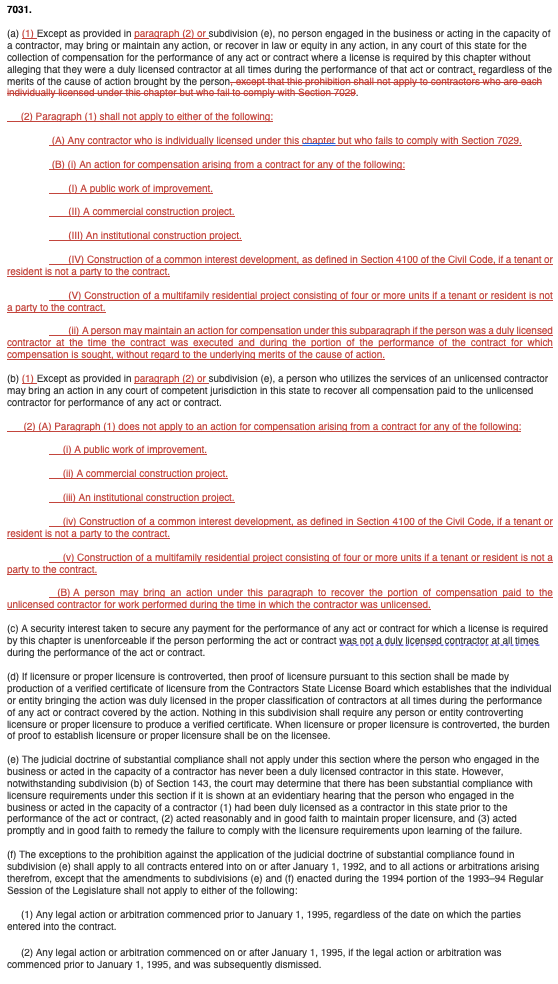
The “all-or-nothing” rule is about to change though with the enactment of Senate Bill 342 which takes effect on January 1, 2027. Under SB 342, the claim preclusion and disgorgement provisions of Section 7031 only apply to work performed while unlicensed. Thus, under Section 7031 as amended, a contractor will only be precluded from suing for compensation for work performed while it was unlicensed. Similarly, a property owner will only be able to seek disgorgement of money paid while the contractor was unlicensed.
Of note, is that while the new law does not take effect until January 1, 2027, after goes into effect, it will apply to all claims under Business and Professions Code section 7031 even those that arose before January 1, 2027. Thus, for example, if a contractor performed work without a license in early 2026 but later obtained a license in late 2026, the new law would apply even though it did not take effect until January 1, 2027.
For those of you who are legislatively-inclined, here is a redline of Business and Professions Code section 7031, showing the amendments in red:
Shout out to Shay Kulkarni of Peckar & Abramson, P.C, a fellow construction attorney (who is excellent by the way), for bringing this to my attention.


Leave a Reply